


HINTS AND TIPS FOR AMAL TYPE 46 CARBURETTER
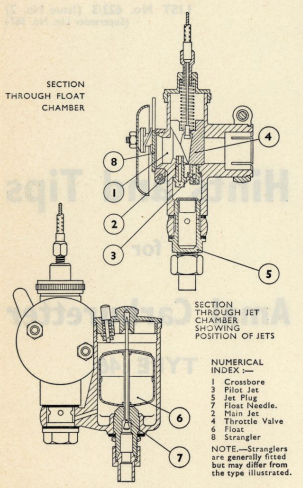
HOW THE CARBURETTER WORKS.
The petrol enters the float chamber through the needle valve port past Float Needle (7) and is kept at a constant level by the float (6) above the calibrated orifices in the base of the jets (2) and (3).
When the throttle valve (4) is nearly closed the bottom of the throttle forms an air passage over the pilot jet (3) and the suction of the engine causes petrol to flow through this jet and become atomised in the air stream; the main jet (2) being inoperative as it is masked by the throttle.
As the throttle is opened the main jet (2) becomes unmasked, and is subjected to the suction of the engine according to the effect of the cutaway of the throttle. Eventually, if the throttle is lifted above the main jet, this jet comes into full operation and its discharge, and the airflow, are controlled by the speed of the engine and the crossbore (1) diameter.
The two-jet action is simple and self-compensating, as while opening the throttle brings the main jet into fuller operation, the intensity of the suction on the pilot jet diminishes.
TRACING FAULTS.
Make sure the strangler will open wide, and that there is a good supply of petrol to the jets. Verify this by unscrewing the jet plug (5). See that the jets are clear, the chamber free from impurities, and the jets screwed home gently and firmly.
Erratic slow running may be caused by a partially choked pilot jet, a badly worn throttle valve, or air leaks in the induction pipe system.
If the engine runs roughly the pilot jet might be slack or the float chamber flooded.
Lack of Power. This is a main jet matter, providing there is a good petrol supply.
Poor acceleration and spitting in the carburetter as the throttle is opened can be remedied by fitting a smaller cutaway throttle valve.
NOTE — When refitting jets ensure that they are in their correct position, and that the throttle valve closes completely.
TUNING THE CARBURETTER.
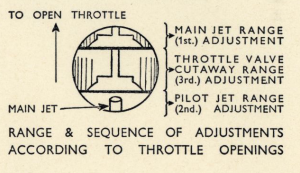
There are three ways in which the quality of the mixture may be varied, and these are given hereunder in the order in which the adjustments should be made:
- 1. Main jet (affects the mixture from half to full throttle).
- 2. Pilot jet (affects the mixture from closed to quarter throttle).
- 3. Throttle valve cutaway (affects the mixture from quarter to five-eighths throttle).
The following circle indicates diagrammatically the crossbore of a carburetter and the three phases of throttle openings;
1. Main Jet.
Fit the smallest size main jet which gives maximum power.
2. Pilot Jet.
This affects "slow running" and slow pulling only; and the smallest size should be selected which gives the best idling.
At the same time, care must be taken not to reduce the pilot jet size unduly, otherwise difficulty will be experienced in obtaining a correct blend with the main jet.
If any trouble is experienced due to a weak spot between the pilot and main jet, it can usually be rectified by increasing the pilot jet one size.
3. Throttle Valve Cutaway.
This affects richness or weakness of the mixture from one quarter to five-eighths throttle opening.
To remedy weakness fit a throttle valve with a smaller cutaway, or in the case of an over-rich mixture, fit a valve with a larger cutaway.
GENERAL HINTS AND TIPS.
Starting from Cold.
Flood the carburetter by depressing the tickler momentarily three or four times, and close the air strangler. Shut the throttle then open it until about one-eighth open; then start.
When started, open the throttle gradually until the engine warms up, then open the strangler.
Should the engine falter either tickle the float chamber again, or partially close the strangler, until the engine is warm enough to run with the strangler fully open.
Starting with Engine Hot.
Do not flood the carburetter, or close the air strangler. Set the throttle as for starting from cold; and start.
If the engine does not start immediately, flood slightly or close the air strangler, and try again. On the engine starting open the strangler at once.
Starting Generally.
Find out by experiment if and how much it is necessary to flood and also note the best position for the air strangler. Usually for starting a small throttle opening is desirable.
Given a good engine and a fat spark at the plug, if the engine will not start the mixture is either too rich or too weak.
Over-richness of the mixture, especially with petroil lubrication, may be caused by overflooding, or by the machine being left when not in use with the petrol tap turned on and the float chamber flooding.
To clear this over-richness open the throttle wide, also the strangler, and turn the engine over several times, then close the throttle and start again.
If the engine does not start at once, the sparking plug points may have become wet or oiled up, so remove the plug and dry the points.
Whilst the plug is out, open the throttle and again turn the engine over several times. Replace the plug then try starting again without flooding and with the strangler open.
Cable Control.
See that there is a minimum of backlash when the control is set back, this is done by the adjuster on the top of the carburetter.
NOTE.-See that the throttle shuts down freely.
Petrol Feed.
To verify, detach petrol pipe union at the float chamber end; turn on petrol tap momentarily and see that the fuel gushes out.
Avoid petrol pipes with vertical loops, as they cause air locks.
Flooding may be due to a worn or bent needle, or a leaking float, but nearly all flooding with new machines is due to impurities (grit, fluff, etc.) in the tank so clean out the float chamber periodically till the trouble ceases.
If the trouble persists the tank might be drained, swilled out, etc.
Air Leaks.
Erratic slow running is often caused by air leaks, so verify there are none at the point of attachment to the cylinder or inlet pipe.
In old machines air leaks are often caused by a worn throttle, or worn inlet valve guides if a four-stroke engine.
Bad Petrol Consumption.
In new machines this may be due to flooding caused by impurities from the tank lodging on the float needle seat, thus preventing the valve from closing.
If the machine is several years old, flooding may be caused by a worn float needle valve.
Faults.
Read Tracing Faults. The trouble may not be carburation: If the trouble cannot be remedied by mixture adjustments, and you know the petrol feed is good, with no carburetter flooding, then the trouble lies elsewhere.